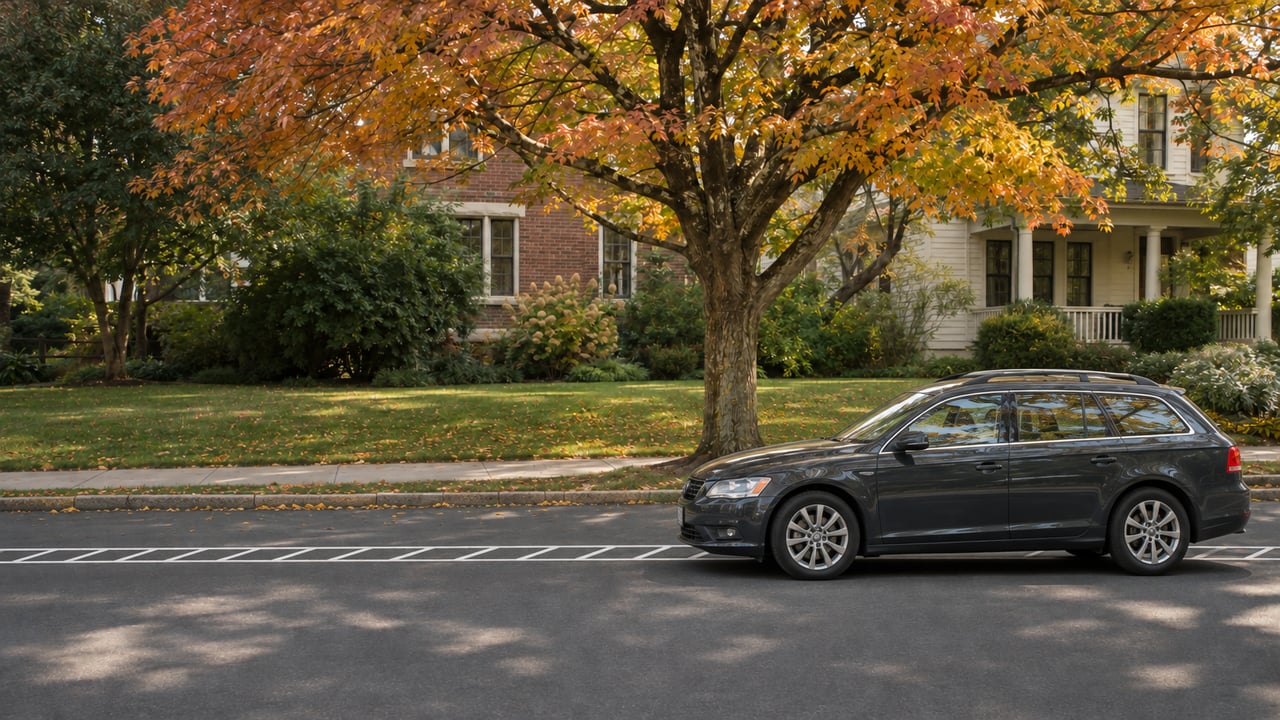
North of Blair Boulevard, Belmont Boulevard already looks unusual. The bike lane runs along the curb, and parked cars sit one lane farther out, between the people biking and the moving traffic. NDOT installed that layout as a pilot between Portland Avenue/18th Avenue and Blair. The city's review called the results "overwhelmingly positive" and recommended converting the rest of the bikeway the same way "as opportunity allows."
The repaving south of Blair carries that conversion forward. The Belmont Boulevard Bikeway Improvements Phase 2 project is tied to a repaving that runs from Graybar Lane up to Compton Avenue. The new bikeway design covers Graybar to Blair, so the floating parking lane that people north of Blair have been parking in will continue south through the residential stretch of the boulevard. If you park on Belmont in front of a friend's house, a church, or a coffee shop, the pilot block is the best preview of what you'll pull into once the new stripes are down.
Where the Work Stands This Week
NDOT's October 2026 update says milling began the week of October 12 and would take about seven days, weather permitting. Crews worked in three phases: the southern section first, then the northern section, then the middle. The order was chosen to speed up reinstalling the loop wire that triggers the traffic signals. Paving was scheduled to begin November 2, also weather dependent.
While crews are working, the rule for parking is simple. No-parking signs go up in active work areas and list the specific hours when parking is restricted. Outside those hours, parking is available. In practice, read the posted times on the sign at your block rather than going by what the block next door allowed yesterday.
The project falls in Council District 18, represented by Council Member Tom Cash, and District 25, represented by Council Member Jeff Preptit. The NDOT project page is where the next update will appear.
The New Cross-Section, From the Curb Out
The Phase 2 plan set, dated September 2026, draws most of the corridor between Woodmont Boulevard and Compton Avenue with the same repeating dimensions. Starting at the curb and moving toward the center line:
- A 5-foot bike lane against the curb
- A 3-foot buffer
- A 7-foot parking lane
- The travel lane
The 3-foot buffer separates the parked cars from the bike lane and keeps the parking lane from feeling like part of the bike lane.
The drawings name the side streets residents use to get on and off the boulevard: Rosewood, Dallas, Sweetbriar, Beechwood, Linden, Ashwood, Wildwood, and Paris Avenues, plus Cedar Lane and Kirkwood Avenue. The legend for this section calls for crosswalk markings, in-street pedestrian-yield signs, flexible delineators, and bike and scooter corrals. The existing "left bike right parking only" signs are slated to be replaced with bike-lane signs.
The short southern segment between Graybar Lane, Clairmont Place, and Woodmont Boulevard is drawn differently. It has a 5-foot bike lane, a 10-foot travel lane, a 10-foot turn lane, and proposed crosswalk markings. NDOT's overview of the full project also lists turn-hardening, new planters, better-aligned lanes, and improved route signage.
What the Pilot Block Taught Drivers
The pilot gives this project a track record. In NDOT's case study, 81% of almost 180 survey respondents said the pilot bikeway was working well. The companion outreach report separates the two halves of the design. Of its 179 short-survey responses, 80.5% said the protected bikeway worked well, and 78.8% said the on-street parking worked well.
The parking number is the one that matters for anyone who parks on the boulevard. It sat a little below the bikeway number, and the case study chose one comment to represent the complaints it did get:
"It is very confusing. Drivers don't understand they can park and most of the time, if they do, they block the bike lane."
That complaint describes two different mistakes. The first is not recognizing a parking lane that sits away from the curb as a place you're allowed to park. The second is pulling all the way to the curb out of habit, which puts the car in the bike lane. NDOT's suggested fixes were clearer signs and pavement markings, more delineation, and enforcement where appropriate. Phase 2's plan set includes flexible delineators and new bike-lane signs, which are the measures the case study recommended.
In the longer survey, the concerns people listed included limited sight distance, debris or vehicles blocking the bike lane, and car doors opening into lanes that felt too narrow. Phase 2 draws a 3-foot buffer between the parking lane and the bike lane along most of the corridor.
The pilot team also visited businesses along the converted stretch, including Bongo Java, Proper Bagel, Six One Five Deli, Funtime Ramen Bar, and Top Dollar Books. Businesses raised no major concerns beyond occasional vehicles parked in loading zones and a sense that bicycle traffic was light. The team followed up on removing a bollard that had been placed inconveniently.
Why Phase 2 Adds Crossings Along With Paint
The pilot changed where cars park, and drivers on the corridor still moved faster than the posted limit afterward. Average daily traffic on the corridor rose 4% between 2022 and 2024, from 10,273 to 10,693 vehicles per day. In 2024, the average speed measured 29 mph and the 85th-percentile speed was 34 mph, against a posted limit of 25. The case study concluded that more traffic calming would be needed, naming speed cushions and curb extensions as examples.
That conclusion explains why Phase 2 includes more than new stripes. It adds safer pedestrian crossings, in-street yield signs, turn-hardening, and planters. For someone walking from Linden or Ashwood to the other side of the boulevard, those features matter more than the bike lane. Traffic counts suggest the cyclists will be fewer than the drivers. During the pilot, NDOT estimated about 81 bike trips a day, with a peak of 118 in September 2022, compared with more than 10,000 vehicles a day.
The city describes Belmont Boulevard as the link between Lipscomb and Belmont Universities, continuing toward Vanderbilt as it turns into Music Row. It also carries commuter traffic, and the city notes that its speeds and volumes can be uncomfortable for people walking and biking. The new crossings are meant for neighbors walking across a street that carries all of that traffic.
The First Busy Evenings on the New Street
The first real test of the new layout will be the holiday events that bring visitors to the corridor. The day after this post publishes, Christmas at Belmont opens at the Fisher Center, with performances on November 20 at 7:30 p.m. and November 21 at 2 p.m. and 7:30 p.m. More than 600 student musicians are taking part. Many of the people looking for a space nearby that weekend won't have parked on the pilot block before. Depending on where the crews are, some will be reading no-parking signs on the newly paved section as well.
Three weeks later, the Belmont/12 South Art Crawl runs Saturday and Sunday, December 12 and 13. It's a free, self-guided holiday tour of 11 neighborhood stops featuring 25 local and Middle Tennessee artists. A tour with 11 stops means many short trips and repeated parking over the weekend, which is a lot of practice with a lane set off from the curb.
North of Blair, on the block that already has this layout, Hometeam Pizza has been preparing its first brick-and-mortar restaurant at 2017 Belmont Boulevard, in the former Athens Family Restaurant space next to International Market. WhatNow Nashville reported that founders Samantha and Kevin Jackson spent years working out of a shared kitchen in Sylvan Park. The outlet also quoted the company on renovating an older building: "Working with such a historic building has presented many challenges." On that block, parking already follows the order the rest of the boulevard is set to adopt, with the bike lane at the curb and the parked cars between it and traffic.
For more on daily life around the boulevard, our Belmont-Hillsboro neighborhood page collects what we follow there, and our August piece on the Belcourt and the walk to and from it covers the north end of the neighborhood.
A street layout affects how a block functions every day, from where guests park to how easy it is to cross from one side of the boulevard to the other. At Bainbridge Realty Group, we pay attention to changes like this one because they shape how a home on Belmont Boulevard is experienced and how it's shown to buyers. If you live along the corridor and want to talk about how the new street might affect your plans, we'd be glad to have that conversation.